
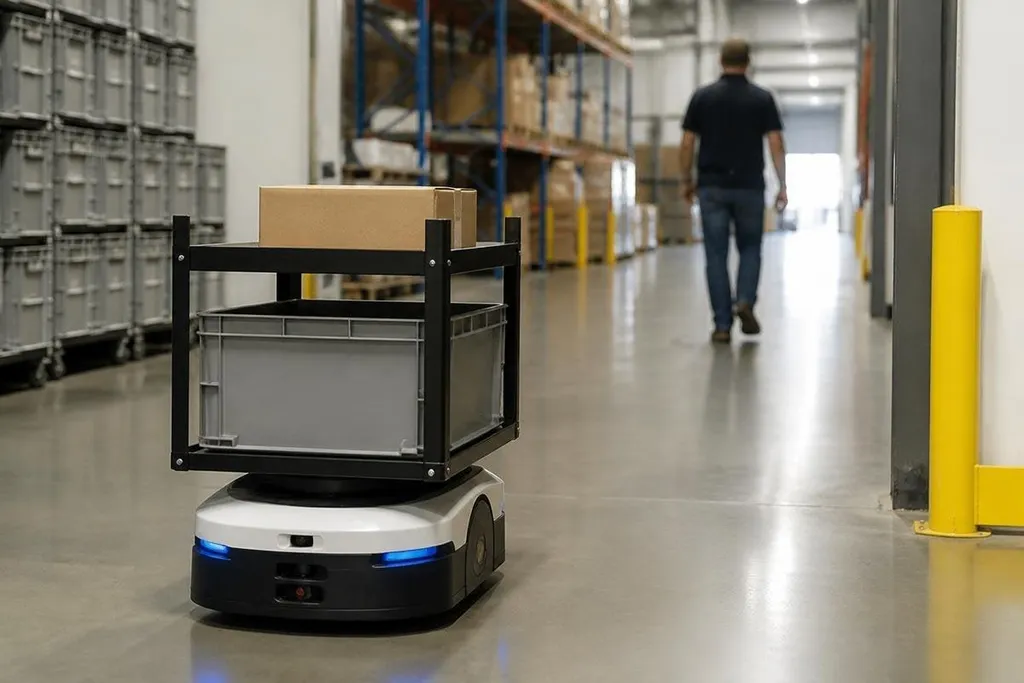
A mobile robot can already move goods, inspect rooms, carry tools, and map indoor areas. The next stage will bring more robots into narrow, repeatable jobs where fixed routes, charging points, and safety rules are easy to set.
- Robots will spread first through indoor routes with steady traffic.
- Better sensors will help them handle people, doors, lifts, and changing floors.
- Human staff will still step in when a task needs judgment or careful handling.
Where mobile robots fit first
The easiest work to hand to a mobile robot has three traits: the route repeats, the load stays within a known range, and a person can take over when the robot stops.
Hospitals, warehouses, factories, hotels, and large offices fit that pattern in different ways.
A robot may carry a sealed box between storage and a work cell, or patrol a set area for signs of heat, smoke, or water. Each job needs a clear map and a safe response when a person blocks the route.
That last part matters because movement is only one piece of the task. The robot must stop, wait, choose another path, or ask for help without blocking a doorway or slowing nearby workers.
Sensors will decide how far they go
Most mobile robots combine several sensors. LiDAR measures distance with laser pulses, cameras help read signs and spot objects, and wheel or joint sensors track the robot’s own movement. Software combines those readings to build a map and estimate the robot’s position.
Many systems use simultaneous localization and mapping, known as SLAM. The robot compares new sensor readings with its map, then updates its position as it moves. Good results depend on the setting: reflective floors, glass walls, dust, poor light, and crowded aisles can all make the job harder.
That is why future systems will need better ways to handle small changes. A box left in an aisle should cause a short detour, not a long stop. A lift door that opens late should lead to a new attempt, not a safety fault that needs a technician every time.
Battery life will set how long future mobile robots can work between charges. A runtime number means more when the report names the robot and task; mobile robot reports from Robot24.com can give you that context before the next section looks at charging.
The battery and charging problem
A mobile robot loses useful time when it waits for power. Many designs return to a dock, connect to charging contacts, and resume work after the battery reaches a set level. That works best when the route and workload are known in advance.
Longer battery life will help, but charging control may matter just as much. A robot that takes short charging stops during quiet periods can keep working without a large battery pack. Fleet software can also send one robot to charge while another covers the same route.
The weak point is peak demand. If several robots need power during one busy period, a site may need more docks, higher electrical capacity, or a work plan that spreads charging across the shift.
The hard jobs stay hard
Mobile robots still struggle with tasks that change shape from one attempt to the next. Picking an unknown object, opening a stuck door, carrying a liquid container, or working across steps needs more control than following a marked route.
Teleoperation can fill that gap. A remote person takes control when the robot meets a case its software cannot handle, then the system may record the event for later review. This reduces the need for a person beside each robot, but it does not remove the need for trained staff.
Safety will also limit where robots can work. Sites need speed limits, emergency stops, warning lights, safe distances, and clear rules for shared spaces. The exact setup depends on the robot, the building, and the work around it.
A buying checklist for the next pilot
Use these checks before choosing a mobile robot for a real site:
- Name the route: measure its length, floor type, doors, lifts, and busy periods.
- Set the load: record the weight, size, grip needs, and handoff point.
- Count the stops: include charging, waiting, human help, and recovery time.
- Test the failure case: place an object in the path and check what the robot does.
- Check the handoff: decide who takes control and how long help may take.
A pilot should measure completed trips, stopped minutes, human interventions, and damaged goods. Those figures tell you more than a smooth demonstration in an empty corridor.
I'd skip a mobile robot purchase if the supplier can't show how the system handles blocked routes and lost network access. The open question is how much unscheduled human help each robot will need after the first month, because that cost will decide which routes make sense.